

Sometimes healing isn’t about leaving the deep — it’s about discovering you can breathe there.
Healing may not mean walking on land — sometimes it’s learning to float, breathe, and feel His light in the ocean we were born to survive.
— Raya Faith, Incarnational Neurodivergence Theory
Published November 3, 2025 (Three days after deliverance)
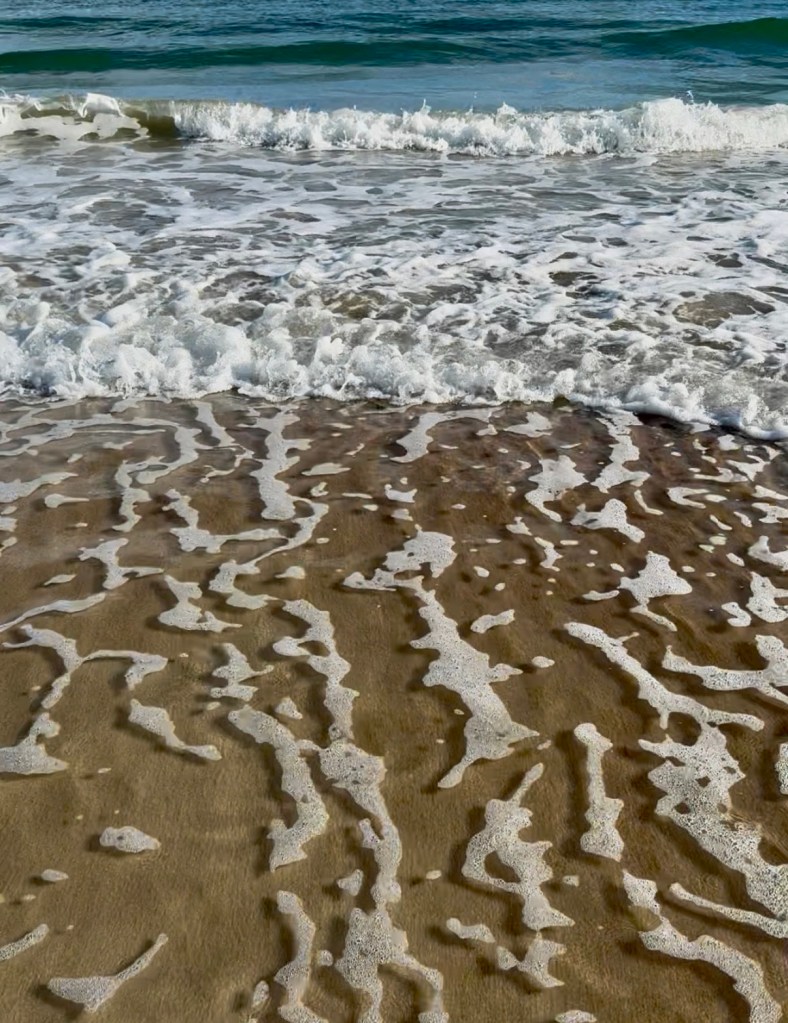
I know these waters.
They have been my habitat since birth —
vast, unpredictable, holy.
For years I thought the goal was to escape
them —
to crawl onto the shore
and prove I was finally “healed.”
But what if the miracle is
not escaping the ocean,
but learning how to live within it
without drowning?
My therapist asked if I wanted to leave the
ocean.
I told her I don’t even know what that means.
The ocean is not my prison anymore.
I am no longer collapsed beneath its waves.
I am not caught in its riptides and undertow.
I’ve learned to swim through its caves
and find treasure —truth, not gold —
and to call that truth holy.
This is what healing looks like for me.
It’s my nature. The only habitat I’ve known.
It once embodied my survival.
Now it embodies my healing.
Not walking on dry land with legs that do not
feel like mine, stationary, rooted,
but learning to float — to rest, to breathe,
to feel the warmth of the sun reach even here.
This is where Real Jesus meets me, always:
not at the surface, but in the shimmering
depths of truth.
Maybe healing isn’t about learning to walk on
solid ground at all.
Maybe it’s learning to float, to rest,
to come up for air and feel His light and warmth
touch the waves —
and touch me.
He touches my face, my hair.
He is both at the surface and beneath it all at
once,
alive in the current that carries me,
alive in the very cells of my body
and the gills that let me breathe here.
He is the pulse that keeps me alive in the deep.
Both can be true:
I can want to keep the only habitat I’ve ever
known — the ocean
and still be transformed within it.
I’ve come to love it like it’s my home.
Safety and healing do not require me to leave
the water.
They happen as I learn to rest —
as His light turns even the salt into something
holy.
So please, don’t pathologize my ocean.
Don’t call it avoidance when it’s sanctuary.
Don’t name my swimming as refusal.
It is how I live. It is how I heal.
The truth sets you free.
I am not afraid of the current anymore.
It has lost its hold.
Real Jesus is helping me master it —
so I no longer live in fear.
Research Note: Incarnational Neurodivergence
For those of us who live at the intersection of faith, neurodivergence, and captivity survival, healing is not about abandoning our nature — it’s about reclaiming it.
The ocean that once held danger becomes the place where breath returns.
The sensory depth, the attunement, the vast perception that once overwhelmed — these become gifts of resurrection.
In this incarnational neurodivergence, we learn that embodiment is not punishment. It is the miracle.
The body becomes both sanctuary and testimony — a living map of divine persistence.
In captivity recovery, the body becomes both sanctuary and testimony — a living map of divine persistence. Each cell, each breath, bears witness to the truth that survival itself is a form of resurrection.
In incarnational neurodivergence, this reclamation is not abstract or symbolic; it is somatic, cellular, and sacred. The body carries the evidence of trauma and the imprint of grace. Healing, then, is not erasing what was endured but embodying what has been redeemed — letting the nervous system learn safety without surrendering sensitivity.
The survivor’s body becomes a sacred archive — where divine persistence is not something merely believed, but something lived.
Clinical Reflection: Co-Regulation and Containment
In captivity recovery, co-regulation is not codependency.
It is not sharing the same waters — it is learning to breathe in rhythm from different shores.
The survivor swims; the therapist steadies her own breath on land.
That shared steadiness keeps the body from reliving isolation without collapsing the boundary.
Safety is not created by entering the ocean together —
it’s created when both remain fully themselves, anchored and attuned,
allowing the survivor to keep swimming and breathing freely.
It is the rhythm of presence without possession,
witness without rescue,
and healing that honors autonomy as sacred ground.
With love,
Raya
 Raya Faith | The Gentle Rise Survivor Sanctuary